You have heard the warnings. “Don’t take a caravan on the Gibb River Road.”
The forums are full of it. The beard-stroking blokes in 79 Series utes swear you will shake your van to pieces before you even hit El Questro. Are they right? Our experience says otherwise.
We found that the Gibb River Road for caravans is absolutely doable if you pick the right rig and prep properly. We towed our off-road hybrid through every corrugation, every creek crossing, and every red-dust kilometre of this 712 km icon. Our deviation to the Mitchell Plateau did not disappoint.
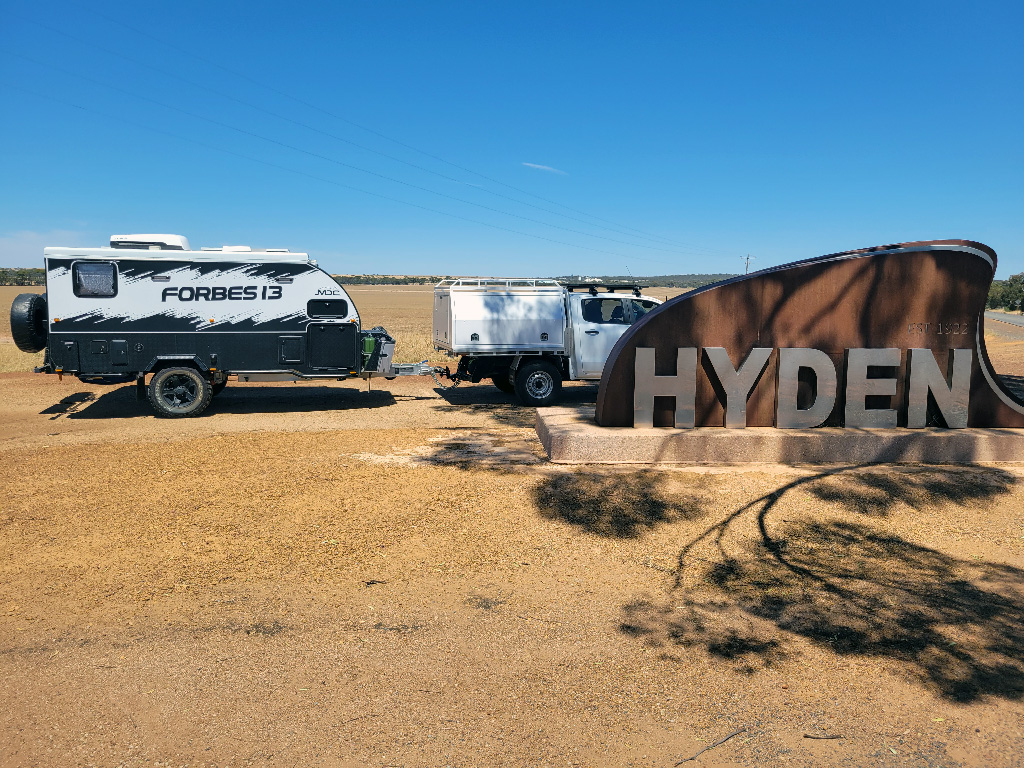
The obligatory photo of our off-road caravan and the old road condition sign. The new sign is visible in the background.
That said the Gibb River Road commands respect, even if the occasional bold solo traveller proves you can limp a 20-year-old Corolla across the full length. But if you’re towing your home-on-wheels and want to finish the track with your rig, cupboards, and marriage intact, preparation and vehicle suitability are non-negotiable.
This hub is your complete resource for the route between Derby and Kununurra. Whether you are planning our 8-day express trip or the full 14-day journey (divided into Part 1: East and Part 2: West), we have detailed the specific vehicle prep, tyre pressures, and caravan-friendly campsites needed to navigate the Kimberley safely.
Each of the itineraries below comes with its own free interactive map.
Duration: 8 to 17 Days (depending on selected options and pace)
Distance: 712 km total (Kununurra to Derby) | 650 km main track + 106 km station access roads (El Questro 32 km, Mt Elizabeth 60 km, Manning Gorge 14 km round trips). Taking the Mitchell Plateau option adds a further 326 km of unsealed roads.
Start / Finish: Kununurra / Derby (or reverse)
Best Months: May to September (Dry Season)
Road Conditions: ~576 km unsealed road (including access roads) and severe corrugations with short sealed sections; sharp shale, washouts, and active river crossings
Caravan Suitability: Single-axle off-road caravans, heavy-duty off-road campers, and rugged 4WD setups only (Standard on-road caravans and low-clearance rigs NOT recommended)
Camping Cost: moderate for station stays, high at El Questro and we lean heavily on free camps
Fuel Availability: Available at El Questro, Ellenbrae (diesel/unleaded emergency), Mt Barnett, and Imintji (Diesel only). Maintain a minimum 600 km working fuel range
Mobile Reception: Extremely limited/none (Telstra coverage at select stations only). Starlink or Satellite Communicator strongly recommended
Pet Suitability: Not Recommended but possible (Restricted in National Parks like Silent Grove/Bell Gorge, and presence of baits/crocodiles)
Highlights: El Questro Gorge, Emma Gorge, Manning Gorge, Bell Gorge, Windjana Gorge, Tunnel Creek, iconic Kimberley boabs
Difficulty: Advanced Off-Road / Remote Towing
Who This Trip Suits: Self-sufficient off-road tourers, experienced towers, and adventure travellers prepared for remote maintenance and dust management
Last Verified: July 2026
A note on the length of the Gibb: the astute may have picked up that we are using 650 km as the length of the Gibb River Road. The Gibb River Road is commonly cited as 660 km in older guides and online forums. Thanks to modern road realignments and straightening over the years, the actual track length between highway turn-offs is around 647 km. We round this to 650 km for our baseline calculations (before adding station access roads).
Is Your Caravan OK for the Gibb River Road?
This is a common concern so let’s be direct. Not every caravan belongs on this road.
What Works
Hybrid campers and off-road camper trailers: Built for this exact terrain.
Full-size tandem-axle vans with road-biased tyres.
Anything with pop-out sections or slide-outs.
Rigs where ground clearance is an afterthought.
Just to be clear: a standard caravan will not cut it on this road.
When we took our hybrid through, the independent suspension earned its keep.
Bottom line: If your van wasn’t designed for corrugations and creek beds, it’ll tell you in an expensive manner.
The Gibb River Road for Caravans
The 712 km stretch between Derby and Kununurra isn’t a monster. It’s a test of your setup, your tyre pressures, and your willingness to slow down. The people who fail usually make their mistakes before they even hit the dirt. As a side note, the unsealed section of the Gibb River Road is about 470 km.
Key takeaway: The Gibb doesn’t hate caravans. It hates poor preparation and unrealistic expectations.
We have divided this guide into two parts. We’ll soon cover the technical prep (the “How”). However, we’ll first provide our field-tested itineraries (the “Where”):
The 14-Day Full Experience: A deep-dive journey split into two manageable legs, with an optional side-track to Mitchell Plateau.
The 8-Day Express: A strategic traverse for those with limited time who still want the best of the Kimberley.
If you do this itinerary in reverse, you may have plans to continue east from Kununurra and perhaps as far as Cairns. If so, you may like to have a look at our Savannah Way Itinerary. This maps out the exact route we took.
The Budget Reality
A Kimberley trip shouldn’t require a second mortgage. While the stations offer great facilities, we’ve designed this itinerary to be budget-conscious. By mixing iconic station visits with high-quality free camps, you save your money for the “must-pays” like fuel and the Mitchell Plateau permits without missing the magic.
The Gibb River Road Map
To aid in your planning, we have carefully prepared a map of the route and an optional side trip to Mitchell Falls. Later in the article, there is an interactive map for more information (jump to interactive map).
Choose Your Path
The Gibb rewards patience. Pick the itinerary that matches your time and appetite for adventure.
When you dive into the itineraries, you will find that they are budget-friendly. We prioritise free camping over campgrounds with all the bells and whistles. However, we don’t skip station stays when there is a benefit.
The Full Experience (14 Days)
The complete Kimberley immersion. Two legs, one unforgettable crossing.
Kununurra to Gibb River Campground (Days 1-6)
El Questro. Emma Gorge. The Pentecost River crossing. Home Valley Station. This first leg delivers the Gibb’s most accessible highlights with strategic rest days built in. We also provide a summary for those wishing to complete the trip in the opposite direction.
The Mitchell Plateau deviation branches north from the Gibb near Gibb River Campground. It adds three days to your journey but rewards you with Mitchell Falls, the Kimberley’s most spectacular tiered waterfall system.
Critical: This track demands off-road capability. Smaller hybrids and off-road campers can manage it; you need to exercise extreme caution with larger rigs. We detail the access requirements, camping options, and helicopter alternatives on the dedicated page.
Manning Gorge’s legendary swimming hole. Bell Gorge’s amphitheatre falls. Windjana Gorge and Tunnel Creek for the geological finale. The western half delivers the Gibb’s most photogenic country.
Limited leave? The 8-day version strips back the rest days but keeps the essentials. You’ll move faster, camp less at each stop, and still tick off the must-see gorges.
Best suited for: Experienced tourers comfortable with longer driving days and minimal downtime.
Here’s our philosophy on Kimberley off-road travel: nimble beats luxurious every single time.
Smaller Setups, Bigger Adventures
When we see someone wrestling a 7-metre van through the Pentecost crossing, we’re grateful for our compact hybrid. Here’s why smaller makes sense on the Gibb:
Tighter turning circles for narrow station tracks.
Less weight means less stress on every component.
Lower centre of gravity reduces rollover risk on off-camber sections.
Easier recovery if (when) you get stuck.
More campsite options: some bush sites can’t fit larger rigs.
We’ve camped in spots that 22-footers couldn’t dream of accessing. That flexibility is the whole point.
The Right Mindset
Towing on the Gibb isn’t about proving your rig can handle it. It’s about experiencing an area that most Australians never see.
Slow down. 60-80 km/h maximum on corrugations.
Stop often. The gorges, not the kilometres, are the reward.
Be self-sufficient. Carry water, fuel, and food for delays.
Respect the land. Traditional Owners and station operators permit access to their country. Honour that.
Adcock Gorge is a hidden gem. We had the place to ourselves as we camped nearby and went late in the day.
Vehicle & Van Prep: What Actually Matters
Towing on the Gibb starts weeks before you leave the bitumen. Here’s our pre-trip checklist, built from hard lessons.
Tyre Pressures
This single adjustment makes or breaks your trip.
Recommended PSI Settings (Unsealed Sections)
Vehicle/Van
Highway PSI
Gibb PSI
Notes
Tow vehicle (front)
36-40
30-32
Adjust for load
Tow vehicle (rear)
40-45
28-32
Lower = better absorption
Caravan tyres
45-60
32-45
Weight-dependent
Key principles:
Lower pressures let tyres absorb corrugations rather than transmitting them.
Check pressures every morning when tyres are cold, as temperature changes affect readings.
Re-inflate when returning to sealed roads.
Carry a high-quality 12V compressor (minimum flow rate of 150 L/min).
We ran our hybrid at 34 PSI on the Gibb. The difference from highway pressures transformed the ride.
Kimberley bulldust penetrates everything. Work out how to seal your van before you leave home, not at the first roadhouse.
Essential dust-proofing steps:
Apply closed-cell foam tape around all external hatches and access panels
Fit fine mesh filters over van air vents.
Seal gaps around doors and windows with masking tape.
Zip-lock all electronics, cameras, and important documents.
Store bedding in sealed compression bags.
Rob’s Tip: You may want to test your caravan on unsealed roads before doing long trips like the Gibb. This will identify any ingress points. You may find that your caravan is dust-proof. Ours had a few spots that needed attention. Silicone, duct tape and stick-on matting worked really well. I couldn’t get into one spot, so I rammed a rag into the space to stop the dust.
Weight Distribution
Heavy rigs struggle. Overloaded rigs break. If you have not considered this, you can see our information on Caravan Towing Weights.
Know your actual weights: get a weigh slip before departure. We have used GoWeigh for this. It was the first stop on our two-year lap.
Move heavy items low and near the van’s axle(s).
Ball weight should sit at 8-10% of ATM (unless you have extensively tested your stability).
Leave the “just in case” items at home.
Every extra kilo amplifies on corrugations.
Mechanical Integrity
Pre-Trip Checklist
Complete these before leaving home:
Wheel bearings repacked/inspected
Brake pads with a minimum 50% life remaining
Shock absorbers in good condition (no leaks, firm rebound)
All suspension bolts torqued to spec.
Fresh fan belts and radiator hoses
Spare fan belt carried
Tow hitch and safety chains inspected
Rob’s Tip: If you develop an issue with your caravan or 12V system before departing Kununurra, the guys at TJ Adventures will sort you out. They offer a Gibb River Road safety inspection.
Spares to Carry
Two full-size spares (one for the vehicle, one for the van at a minimum).
Tyre repair kit and plug kit.
Spare wheel bearing and races.
Basic tool kit with socket set.
Cable ties, duct tape, wire.
Rob’s tip: Every couple of days during the trip, get under the caravan and check the suspension and shocky bolts. We came across someone on Cape York who lost a complete suspension assembly on one side. Checking the bolts may have prevented that.
Station & Campsite Directory
Every stop on the Gibb has its own character. Our detailed reviews cover facilities, costs, booking requirements, and honest assessments.
Eastern Gibb (Kununurra Side)
El Questro Station: The gateway station. Multiple camping tiers, hot springs, gorge access.
Home Valley Station: Working cattle station. Resupply point, Cockburn Ranges views.
Never pass a bowser with less than half a tank. Fuel stops East to West:
Kununurra (full tank start)
El Questro
Home Valley Station
Ellenbrae Station
Drysdale River Station
Mt Barnett Roadhouse
Imintji (diesel only)
Derby
Tip: Prices increase the further from town. Budget $2.99-$3.40/L at remote stations (at mid-July 2026). For example, diesel is $2.99 at El Questro and $3.30 at Mount Barnett (checked 17/07/2026).
Communications
Mobile coverage: Virtually non-existent between El Questro and Derby.
Starlink: provides a total communication solution.
UHF radio: Channel 40 for vehicle-to-vehicle.
Station reception desks: able to help with communication in case of an emergency.
When to Travel
Dry season only: May to October.
Roads close during the wet (November to April). Early dry (May to June) may see sections still impassable. Check Main Roads WA alerts before departure and at each station.
How to Do the Gibb on a Budget
The 3-for-1 Rule: For every paid station stay, aim for three nights of free camping.
Self-Sufficiency is Key: The more water and solar you carry, the less you rely on $50+ powered sites.
The Permit Priority: We redirect our “camping budget” into the Uunguu Visitor Pass ($55 each). It’s the one expense you shouldn’t skip. The pass is only required for those taking the option to travel to Mitchell Falls.
Eat at Home: Stations are famous for scones and burgers, but at $20+ a pop, they add up. We treat those as rare rewards, not daily staples.
Ensure that you depart Kununurra or Derby with full tanks and jerry cans.
The Kununurra ‘Last Call’ Checklist
Before you leave Kununurra, confirm:
Rig suitability verified (see filter above).
You can deflate and inflate your tyres.
Van is sufficiently dust-sealed.
Weight distribution checked (8-10% ball weight).
Two full-size spares loaded.
Satellite communicator charged and registered.
Campsite bookings confirmed (applicable only for El Questro and if you wish to have a powered site at stations that offer them).
Water capacity for 5+ days (minimum 4L/person/day).
Food supplies for unexpected delays.
Itinerary downloaded/printed (no mobile reception).
A Logistical Warning
There is one service missing on the Gibb River Road. There are no dump points between El Questro and Derby. You will need to come up with your own plan for dealing with this. Obviously, when you are in a campground with facilities, make use of them.
One thing you must not do is dump your canister into a toilet that uses a septic system (assume that they all are unless you know otherwise). Toilet chemicals kill bacteria in a septic system, preventing it from functioning correctly. Ever come across a drop toilet that stinks to high heaven? Almost certainly, someone has done the wrong thing and emptied their waste into it.
Ready to Plan Your Route?
The preparation is done. Now choose your adventure:
While the Gibb is a remote location, it has a twin that is much less well-known. If you have not heard about Duncan Road, you may like to read about our 8-Day Bungle Bungles & Duncan Road Loop itinerary.
Interactive Gibb River Road Map
Below is our free interactive Gibb map. The map shows campground locations, points of interest, starting points for walks, and fuel locations. Zoom in to see more details. Click the markers for more information.
For those who jumped to the interactive map, you may return to the static map: click to return.
How Did Our Setup Go on the Gibb River Road?
There are lots of reports of people damaging their cars and/or caravans on the Gibb. We did not suffer any damage. We didn’t even get a single flat tyre. Our gear performed faultlessly. The only thing was a little dust got into the van.
What Would We Do Differently?
The Gibb is so remote that there is some stress to ensure that everything is covered. This has the effect of forcing you to think very carefully before heading off. Fortunately this resulted in us having a stress-free trip. There are only a couple of small things that we would do differently next time:
Upgrade Our Lighting for Tunnel Creek: We made do using our phones. That got the job done but it isn’t ideal. If we did it again, we’d pack bright, waterproof headlamps for Tunnel Creek. Balancing on slippery, submerged limestone ledges in chest-deep water is infinitely easier (and safer) when you have a bright, hands-free light rather than holding a torch or relying on a phone light.
Vacuum-Seal All Fresh Meat Before Leaving Town: While we stocked up well in Kununurra, vacuum-sealing meat into exact daily meal portions before hitting the dirt is a game-changer. It lets everything lie completely flat in the 12V freezer, maximises precious space and keeps food fresh much longer.
Final Words
The Gibb River Road for caravans is a commitment to preparation, to patience, and to respecting what this country demands. Get those three right, and you’ll access gorges, swimming holes, and landscapes that most Australians only see in documentaries.
Towing on the Gibb isn’t reckless. Towing unprepared is.
Use this hub as your technical foundation. Let our itineraries guide your daily movements. And when you’re standing in Kununurra, you’ll know exactly what to expect.
Questions about your specific rig or setup? Drop them in the comments or reach out via our contact page. We answer every message.
Get exclusive Aussie road trip itineraries, caravan tips from the track, and destination guides that most travellers never find — delivered straight to your inbox.
No spam, ever — just good yarns and better destinations.
Unsubscribe anytime with one click.
Lead content creator and veteran overlander behind Road Trip Nomads. Having completed a full 47,500-kilometre lap of Australia towing an off-road hybrid caravan, Rob provides first-hand, un-sponsored guides to remote itineraries, off-grid 12V electrical systems, and regional campgrounds. Combining a 20-year technical background in critical industrial sensors with a passion for remote travel and astrophotography, he delivers practical, field-tested advice for self-sufficient regional exploration.